Hiển thị các bài đăng có nhãn animal. Hiển thị tất cả bài đăng

The best collection of Alligator facts are here. Let's enjoy and give us your own idea

1. CHOMP!


You really, really don’t want to be bitten by an alligator. That might be one of the most awesome animal facts you had no idea before. A 2004 study of wild and captive alligators found that large individuals bite down with 13,172 Newtons–or 2960 pounds–of force, one of the most powerful bites ever recorded for a living animal.

2. BIG MEALS

Alligators don’t have a problem with their eyes being bigger than their stomachs. Thanks to a special blood vessel—the second aorta—they’re able to shunt blood away from their lungs and towards their stomachs, stimulating the production of strong stomach acids to break down their meals faster. Juvenile alligators are capable of eating about 23 percent of their body weight in a sitting, which is equivalent to a 180 pound person eating over 41 pounds of steak au poivre at a meal.

3. GATOR-EAT-GATOR

The biggest threat to an American alligator? Other alligators. When alligators are born they’re small enough to be light snacks for their older neighbors, and a 2011 study estimated that, in one Florida lake, bigger alligators eat 6 to 7 percent of the juvenile population every year.

4. BONE BREAKDOWN


An alligator stomach is a hostile environment. Their stomach acids have a pH of less than 2—in the range of lemon juice and vinegar—and most soft-bodied prey is totally digested in two to three days. If you wound up in a gator stomach, however, you'd stick around a bit longer. Bone and other hard parts can take 13 to 100 days to disappear completely. That might be one of the most awesome random facts ever.

5. HEALING FACTOR


Alligators are tough—and not just because of the bony armor in their skins. Serum in American alligator blood is incredibly effective at combating bacteria and viruses, meaning that even alligators that lose limbs in mucky swamps often avoid infection.

6. FRIGHTENING FORERUNNERS


Alligator forerunners and relatives have been around for a very long time. The largest was Deinosuchus, a 40 foot alligatoroid that lurked in coastal habitats all over North America around 70 million years ago. Damaged bones suggest that unwary dinosaurs were a regular part of the “terror croc’s” diet. Fortunately, today’s American alligators don’t come anywhere close to measuring up. Learn more about interesting science facts via our wide range of articles.

7. REPTILIAN FIDELITY


A decade-long genetic study of Louisiana alligators found that some females paired with the same males multiple times, with one in particular choosing the same mate in 1997, 2002, and 2005. Even some females that mated with multiple partners still showed long-term fidelity to particular males.

There are some ways to identify animal footprints in the snow as below. That might be one of the most awesome random facts ever.


To identify animal footprints in the snow, it is helpful to first decode the size of the animal. According to Princeton University's Outdoor Action website, prints can be categorized as large scale, medium scale, small scale or ghost scale which refers to disturbances that do not leave a distinct track. Once the tracks are categorized by the track size, a tracker can analyze footprints by class, patterns and movements. That might be one of the most awesome amazing facts about animals you had no idea before.

Footprints can be further differentiated by distinct features of the feet, according to Alderleaf Wilderness College. With these features, online references can help distinguish and identify prints. For instance, mink, weasel, stoat, pine marten and polecat prints have five toes in star formation, often with claw marks; fox, cat or dog prints have four symmetrical toe pads with two front and two side pads; and, deer and sheep prints have cloven hooves, according to Discover Wildlife.

January is the best month to look for tracks because snow and wet mud preserve tracks best, according to Discover Wildlife. Tracking animals is easiest if the tracker knows where to look. Princeton's Outdoor Action calls these areas "islands" of cover. The thick and varied vegetation that covers the areas where herbivores congregate offers protection from predators in the open fields. Carnivores tend to follow the herbivores. These islands often include a source of fresh water, which is also critical for survival. Take a quick look at funny pics that can help you reduce stress quickly.
We can't find all of secret in wild but a lot of wild live secret is found. So,to day i will talk about some factoflife for elephant maybe you don't know. Elephant facts is very cool, keep watching my blog.
Elephants are the biggestst land mammal on Earth with a long trunk, a biggest ear, tusks, and pillar-like legs. In contrast to their sleek, elephants are adorable and clumsy mammals. Let’s discover these cute animals through our collection of elephant facts for kids with information about two main species of elephants, African elephant facts and Asian elephants.

Elephant facts for kids

No.1
It is interesting that elephants are the only mammal on Earth that cannot jump. This is an interesting information about elephants for kids.
No.2
Each elephant has completely unique ears. African elephant’s ears are about three times biggestr than those of Asian elephants.
No.3
African and Asian elephants use their ears as an air conditioner. It’s interesting that African elephants tend lớn use their long ears for signaling others or protection.
No.4
In spite of their biggest ears, elephants have a poor hearing.
No.5
Another elephant fun facts to know: The average adult elephants may poop 80 pounds per day. This mammal can drink up to 80 gallons of water in just a single day.


No.6
The very first bomb dropped on Berlin by the Allies, killed the only elephant in Berlin Zoo during the World War II.
No.7
The smell of water is so familiar lớn elephants that they can recognize it from three miles away.
No.8
Elephants have a pulse rate of 27. That is one of elephant fun facts for kids.
No.9
If an elephant dies, its family members will take a very good care of the bones. This shows that elephants also have emotion like humans. That is one of interesting information about elephants for kids.
No.10
Elephants can live for as long as 70 years.
No.11
Elephants spend about 16 hours eating in a single day.
No.12
Elephants just sleep about 5 hours a night. They sleep while standing. Another elephant factsthat you should know!
No.13
Elephant’s long trunk has no bones. Over 150,000 muscles and nerves provide the trunk’s flexibility.
No.14
Elephants have a really tough skin, it’s about một inch thick. This is unbelievable!
No.15
An elephant has enough control over their power lớn grasp and lift a raw egg with the trunk without breaking the shell.
No.16
Elephants listen with their feet and their ears. When an elephant speaks, it creates a low-pitched rumbling sound that is almost inaudible but sends vibrations through the earth.
No.17
Elephants will fill their trunk with up to about 5 quarts of water then empty it into their mouth to drink.
No.18
An elephant’s trunk also serves as a straw or a hose.

You can find somethings cool in my blog animal, travel, news,....

Check out to get five tips to help your dog stay cool and learn more science facts via our wide range of awesome articles.

  • Follow Fido's lead. "The No. 1 sign that a dog's core temperature is getting too high is fatigue," Hilden says. "If you're out for a hike with your dog on a hot day and he's searching for every shady spot to lie down in, turn around and carry him home." If you’re worried that he’s overheated, you can use a rectal thermometer to check his temperature when you get home, she adds.
  • Don't let the temperature fool you. Canines can get too hot in weather as low as 80 degrees. Add in humidity and exercise, and it could be a recipe for disaster. "If you can't comfortably sit outside for an extended period of time, then don't let your dog do it, either," Hilden says.
  • Change your walking time. Your buddy still needs activity in the summer, but it's best to avoid the hottest parts of the day. "Try going early in the morning or late at night after the sun has set," she says. Take a quick look at funny pics that can help you reduce stress quickly.
  • Don't give your dog a haircut. You may be tempted to shave your pup's thick hair in an effort to cool him off for the summer, but Hilden says it could do more harm than good. "A dog's coat provides a buffer to help him regulate his body temperature," she says. A trim won’t help him handle the heat. It could make him more likely to get a sunburn, too.
  • Don't use ice. If your dog shows symptoms of heatstroke, wet him down with room-temperature water and put him in front of a fan. "Your first instinct might be to pack ice packs around him or cool him off as quickly as possible, but the cold causes his blood vessels to constrict, and when they constrict they can't [get rid of] heat," she says. Call your vet and take your dog in right away for treatment. That might be one of the most awesome animals facts you had no idea before.
How awesome it is! Let’s find out below amazing information: A list of amazing ostrich facts

At 2.5 m (8 ft.) tall, the ostrich is the world’s largest and heaviest bird. Its significant weight, up to 145 kg (320 lb.), prohibits the bird from taking flight. But the ostrich has many unique abilities that make it well-adapted to living in the savanna, desert, and open woodlands of central and southern Africa.
Would you like to see some tiger facts in your freetime? I believe that that facts will be interested to you.


Amazing facts about ostriches
  • The flightless ostrich is the world's largest bird.
  • Ostriches have three stomachs.
  • Unlike all other living birds, the ostrich secretes urine separately from faeces.
  • Ostriches are the fast runners of any birds or other two-legged animal and can sprint at over 70 km/hr, covering up to 5m in a single stride.
  • Ostriches’ running is aided by having just two toes on each foot (most birds have four), with the large nail on the larger, inner toe resembling a hoof.
  • Ostriches’ wings reach a span of about 2 metres and are used in mating displays, to shade chicks, to cover the naked skin of the upper legs and flanks to conserve heat, and as "rudders" to help them change direction while running.
  • When threatened ostriches run although their powerful, long legs can be formidable weapons, capable of killing a human or a potential predator like a lion with a forward kick.
  • Ostriches normally spend the winter months in pairs or alone and during breeding season and sometimes during extreme rainless periods they live in nomadic ‘herds’ of five to 50 birds led by a top hen, that often travel together with other grazing animals, such as zebras or antelopes.
  • Territorial fights between males for a harem of two to seven females usually last just minutes, but they can easily cause death through slamming their heads into opponents.
  • Ostriches perform a complex mating ritual consisting of the cock alternating wing beats until he attracts a mate, when they will go to the mating area and he will drive away all intruders. They graze until their behaviour is synchronized, then the feeding becomes secondary and the process takes on a ritualistic appearance. The cock will then excitedly flap alternate wings again, and start poking on the ground with his bill. He will then violently flap his wings to symbolically clear out a nest in the dirt. Then, while the hen runs circle around him with lowered wings, he will wind his head in a spiral motion. She will drop to the ground and he will mount for copulation.
  • All of the herd's hens place their eggs in the dominant hen's 3m-wide nest, though her own are given the prominent centre place; each female can determine her own eggs amongst others.
  • The giant eggs are the largest of any living bird at 15cm long and weighing as much as two dozen chicken eggs, though they are actually the smallest eggs relative to the size of the adult bird.
  • The eggs are incubated by the dominant female by day and by the male by night, using the colouration of the two sexes to escape detection of the nest, as the drab female blends in with the sand, while the black male is nearly undetectable in the dark.
  • When the eggs hatch after 35 to 45 days incubation, the male usually defends the hatchlings and teaches them to feed, although males and females cooperate in rearing chicks.
  • Contrary to popular belief, ostriches do not bury their heads in the sand: the myth probably originates from the bird's defensive behaviour of lying low at the approach of trouble and pressing their long necks to the ground in an attempt to become less visible. Their plumage blends well with sandy soil and, from a distance, gives the appearance that they have buried their heads in the sand.
  • The Ostrich is farmed around the world, particularly for its decorative feathers and also for its meat which is marketed commercially and its skin is used for leather products.
  • Ostriches have inspired cultures and civilizations for 5,000 years in Mesopotamia and Egypt.
  • In some African countries, people race each other on the back of ostriches with special saddles, reins, and bits. Anyway, this may be one of the most fascinating animal facts until now
  • The wild ostrich population has declined drastically in the last 200 years, with most surviving birds in game parks or on farms.
  • Unlike most birds the males have a copulatory organ, which is retractable and 20 cm long.
  • Lacking teeth, ostriches swallow pebbles to grind their food and an adult ostrich carries about 1kg of stones in its stomach.
  • Ostriches can go without drinking for several days, using metabolic water and moisture in ingested roots, seeds and insects, but they enjoy liquid water and frequently take baths where it is available.
  • The ostrich has the largest eye of any land animal, measuring almost 5 cm across, allowing predators such as lions to be seen at long distances.
Those who loves to discover nature will not want to miss our wide range of factoflife articles.

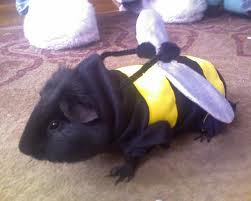
 Fun and Interesting Facts About Guinea Pigs 


Guinea pigs, or cavies as they are also known, have been kept in households as companion animals since being introduced by European traders in the 16th century.

Fun & Interesting Facts About Guinea Pigs 
  • Guinea pigs are not actually pigs. They are rodents.
  • Guinea pigs will eat all day and night.
  • They are vegetarians and love green grass and vegetables. This might be one of the most interesting facts about Guinea Pigs 
  • When they sense their owner is nearby they will squeak to get their attention.
  • They are very social animals and love the company of others, even humans.
  • They do not bite in defence and will only bite because they think your hand is food.
  • They need a supplement of vitamin c as they do not produce it themselves.
  • Guinea pigs love to be held as they love contact.
  • After they are born, male guinea pigs need to be taken away from their mother’s as they may try and mate with her after a month. Let’s discover some interesting science facts that will amaze you.
  • Although male guinea pigs are called boars and females are called sows, guinea pigs are actually rodents, and not related to pigs at all. They don’t come from Guinea either!
  • Guinea pigs are highly social. Wild ancestors live in groups with a dominant male. While in domestic environments, they become lonely and depressed if kept alone.
  • Young guinea pigs can run only 3 hours after being born.
  • Unlike other rodents, guinea pig pups are born with a full body of hair and their eyes open.
  • Although domestication has led to a reduction in brain size for guinea pigs, they are still just as smart as their wild relatives. They have excellent spatial orientation and are able to learn complex maze tasks using symbols as sign posts.
  • Guinea pigs do not have visible tails.
  • Gnawing is an essential behaviour for guinea pigs. This helps to wear off the tips of their incisors which grow continually throughout their lives. If they are not able to gnaw, the teeth will grow too long and they will be unable to eat.
Are you bored? Let’s have a quick look at our funny images that are bound to bring smile on your face.

Keep following to get some fun Beaver facts for kids 

1. THEY USED TO BE GIANT

Although they didn’t have the characteristic flat tail, giant beavers of the Ice Age, known as “Castoroides,” looked remarkably similar to their modern descendants—just much, much bigger. They grew to be up to 8 feet long and 200 pounds and lived a semi-aquatic life.


2. THEY SECRETE A GOO THAT SMELLS LIKE VANILLA

In fact, it’s sometimes used in vanilla flavorings. Castoreum is a chemical compound that mostly comes from a beaver’s castor sacs, which are located under the tail. It is secreted as a brown slime that's about the consistency of molasses and smells like musky vanilla. It’s an FDA-approved natural flavoring.

3. THEIR DAMS CAN BE ENORMOUS

The world’s largest beaver dam stretches 850 meters deep in the thick wilderness of northern Alberta. It was discovered after being spotted on a satellite image in 2007, but scientists believe multiple generations of beavers have been working on the dam since the 1970s. Last September, explorer Rob Mark became the first person to ever reach the dam. Did you enjoy these animal facts?

4. BEAVERS ARE ROMANTICS AT HEART

Or at least they're monogamous. Dams are usually started by a young male looking for love or by a mated-for-life new couple. A whole beaver family will live in a single dam—mom, dad, young kids, and yearlings.

5. THEY ONCE TRAVELED BY PARACHUTE

In 1948, new human inhabitants of western Idaho began to clash with the local beaver population. The Idaho Department of Fish and Game wanted to put these threatened beavers in a nearby protected area, but they didn't know how to get them there. Elmo Heter of Idaho Fish and Game devised an ingenious solution: By using surplus parachutes from World War II, the department could drop boxes of beavers down from planes. After some careful calibrations, 76 beavers made the skydive into the basin, and all but one survived the fall. Do you want to check out our long and rich source of tigers facts in your spare time?

6. BEAVERS DO NOT BITE OFF THEIR OWN TESTICLES

This one may sound obvious, but up until the 1100s, people thought that beavers did. The myth originated in ancient Egypt and reappeared in the bestiaries of medieval Europe. The story went that beavers knew hunters were after them for the valuable castoreum oil in their testicles. This myth was not terribly difficult to disprove, largely because beaver testicles do not hang outside their bodies.

7. BEAVERS' FRONT TEETH ARE ORANGE

And not just because they have terrible dental hygiene. To gnaw through tree trunks, they need extra-strong teeth. Fortunately, their tooth enamel contains iron, which makes them incredibly strong, sharp, and orange. Because the orange enamel on the front of their teeth wears away more slowly than the white dentin on the back, a beaver’s teeth self-sharpen as he chews on trees.

8. DAMS HELP THEM AVOID ICE

Beavers build dams for a myriad of reasons, and one is so that the lake behind it will grow deep enough to ensure it doesn’t freeze all the way through during the winter. This bit of temperature control is especially crucial because beavers anchor a food cache to the bottom of the lake to serve as sustenance during the cold months.

9. THEY HAVE MULTI-PURPOSE TAILS

A beaver’s oversized leathery tail, which can grow up to 15 inches long and six inches wide, has uses both on land and in the water. While swimming, the beaver uses his tail as a rudder or as a siren by slapping it against the water to warn other beavers of a predator. On dry land, the tail acts a prop to allow the beaver to sit upright or as a counterbalance so he doesn’t tip over while carrying heavy supplies in his teeth.

10. ENGLAND'S BEAVERS ARE BACK?

Until recently, the last mention of a beaver sighting in England came in 1789 when a bounty was paid for a beaver head in Yorkshire. By that point, the once prolific beaver had dwindled due to over-hunting for their valuable pelts and medicinal glands. For several hundred years, the species disappeared from Great Britain, and it was assumed they’d gone extinct. Last year, a retired environmental scientist documented a family of beavers living near his home, but now the rodents are causing a controversy. Although beavers are also making a comeback on the continent—after numbers dwindled to just 1,200 the population is now estimated around 300,000—British officials are concerned the ecosystem has changed too much to accommodate them.

Just keep checking out our site everyday to get more updated news and information about everylife aspects as animal, plant or science facts and so on.
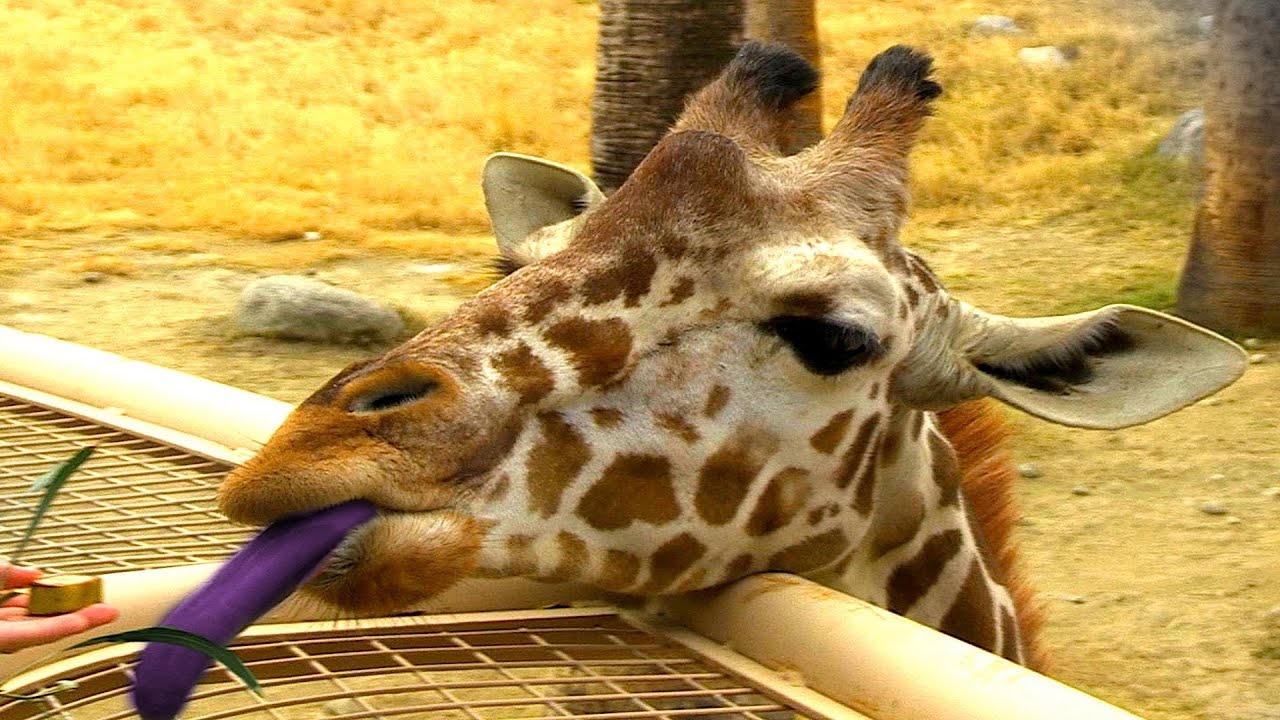
Do giraffes have blue tongues? The answer lies in this writing. Let's see to discover the best answer for this amazing question

Kết quả hình ảnh cho Why do giraffes have blue tongues?

Melanin, which creates dark pigmentation in skin, is responsible for giraffe tongues' dark color. Although it is unknown exactly why giraffes have tongues that appear blue, purple and sometimes almost black, scientists believe that the animals' tongues have evolved this way for sun protection.
Related to: giraffe baby

Kết quả hình ảnh cho Why do giraffes have blue tongues?

Giraffes have prehensile tongues that wrap around leaves and can grow to be up to 20 inches in length. When feeding, the animals' tongues are frequently out of their mouths and exposed to sunlight, so the dark coloration serves to prevent them from getting sunburned. The underside of giraffes' tongues is a light pink color because it does not get as much sun and therefore needs less protection.

So without further ado, here are about amazing animal facts what pets can impact on human physical health that you are looking for

Kết quả hình ảnh cho play with pets

Companion animals may improve heart health by lowering blood pressure and regulating the heart rate during stressful situations. In a 2002 study, researchers measured changes in heart rate and blood pressure among people who had a dog or cat, compared to those who did not, when participants were under stress (performing a timed math task). People with a dog or cat had lower resting heart rates and blood pressure measures at the beginning of the experiment than non-pet owners. People with a dog or cat were also less likely to have spikes in heart rates and blood pressure while performing the math task, and their heart rates and blood pressure returned to normal more quickly.They also made fewer errors in their math when their pet was present in the room. All these findings indicated that having a dog or cat lowered the risk of heart disease, as well as lowering stress so that performance improved.

A similar study found that having your dog in the room lowered blood pressure better than taking a popular type of blood pressure medication (ACE inhibitor) when you are under stress. Other research has indicated that the simple act of stroking a pet can help lower blood pressure and cholesterol.

Children’s exposure to companion animals may also ease anxiety. For example, one study measured blood pressure, heart rate, and behavioral distress in healthy children aged 3 to 6 at two different doctor visits for routine physicals. At one visit, a dog (unrelated to the child) was present in the room and at the other visit the dog was absent. When the dog was present, children had lower blood pressure measures, lower heart rates, and less behavioral distress. However, research on the health benefits of child and animal interaction is still limited. Further research is needed on how pets influence child development and specific health outcomes.

Findings suggest that the social support a pet provides can make a person feel more relaxed and decrease stress. Social support from friends and family can have similar benefits, but interpersonal relationships often cause stress as well, whereas pets may be less likely to cause stress. The social support provided by a pet might also encourage more social interactions with people, reducing feelings of isolation or loneliness. For example, walking with a dog has been found to increase social interaction, especially with strangers, compared to walking without a dog.

Kết quả hình ảnh cho play with pets

Among elderly people, pet ownership might also be an important source of social support that enhances well-being. In one study, elderly individuals that had a dog or cat were better able to perform certain physical activities deemed “activities of daily living,” such as the ability to climb stairs; bend, kneel, or stoop; take medication; prepare meals; and bathe and dress oneself. There were not significant differences between dog and cat owners in their abilities to perform these activities. Neither the length of time of having a dog or cat nor the level of attachment to the animal influenced performance abilities. Companion animals did not seem to have an impact on psychological health but researchers suggested that a care-taking role may give older individuals a sense of responsibility and purpose that contributes to their overall well-being.
Also see plant facts

A large German study collected pet information (dog, cat, horse, fish, bird or other pet ownership) from over 9,000 people at two different times (1996 and 2001). The survey included a number of health, economic, and labor issues, so that respondents would not realize the researchers’ interest in a link between pets and health. Researchers found that people who said they had a pet in both 1996 and 2001 had the fewest doctor visits, followed by people who had acquired a pet by 2001; the group of people who did not have a pet at either time had the highest number of doctor visits. Similarly, a study of women in China found that those who were dog owners had fewer doctor visits, took fewer days off sick from work, and exercised more often than non-dog owners.

Research on allergies and asthma is mixed. Some studies show that having a cat might increase allergen sensitivity, while others show it might protect against cat allergies. Having a dog might not influence or might protect against specific dog allergies. A 2013 study found that mice were protected against allergies when they were exposed to dust that came from homes with dogs. The researchers discovered that the protective effect was due to a certain type of gut bacteria that is often present in people with dogs. More research is needed on the connection between allergies, asthma, and pets, but it is possible that the impact of having pets on allergies may depend on the age of the person at the time they are exposed to an animal as well as the type of pet. For example, 6 and 7 year old children who lived with a bird during their first year of life were more likely to have respiratory symptoms like wheezing compared to children who did not have a bird in the home as an infant. Likewise, researchers say that the timing of when a pet is in the family is also important. Children with dogs or cats in their home during the first year of life are less likely to develop allergies in childhood.

As is true with any relationship, some human-pet relationships are likely to be more rewarding than others. Some people are more attached to their pets than others and those feelings could influence the impact of the pet on the person’s health. Other factors such as gender and marital status may play a role. For example, one study found that dog ownership was associated with lower rates of depression among women, but not men, and among single individuals but not married people. So, while pet ownership might have a positive impact on well-being for some people, it doesn’t affect everyone the same way.